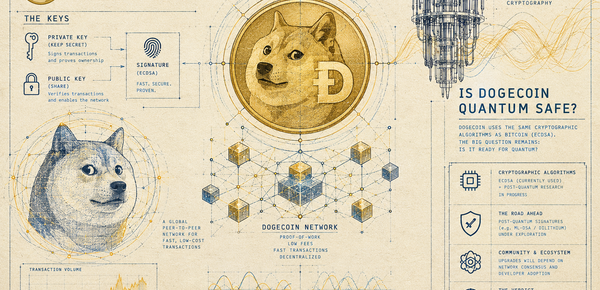
Dogecoin P2PKH addresses hash the public key, so it can stay hidden until you spend, and there's no post-quantum migration on its "done" list. In truth, the Foundation developers have published experimental post-quantum tooling and run mainnet examples, but they're still a long way from a shipped upgrade.
Stay with us for the next few minutes as we cover where Dogecoin's quantum exposure sits and how far its post-quantum tooling has gone, as of October 2026.
Where Dogecoin is today
Dogecoin is a Bitcoin-lineage chain and, naturally, it inherited Bitcoin's cryptography. Transactions are authorized by ECDSA signatures on secp256k1. Shor's algorithm, on a large fault-tolerant quantum computer, can recover a secp256k1 private key from its public key and forge a signature.
That's the core exposure, and it's the same break Bitcoin faces, on the same curve. Dogecoin's scrypt proof-of-work and merged mining are separate from the signature-recovery threat you'll see discussed here.
How Dogecoin handles your public key
Dogecoin's standard addresses work like Bitcoin's legacy ones. The address you share is a Base58Check encoding of a RIPEMD-160 hash of a SHA-256 hash of your public key, so what ends up on the chain is a fingerprint of the key, as opposed to the key itself. Sending DOGE to that address reveals nothing about the key, under the condition that the key hasn't shown up anywhere else.
Dogecoin supports more than one output type, and they disclose keys differently. P2PK outputs expose the key from creation, and for P2SH outputs, exposure depends on the underlying script. Dogecoin hasn't activated SegWit or Taproot, but neither upgrade provides post-quantum signatures, and a fresh Dogecoin P2PKH output has the same basic protection as a Bitcoin P2PKH or P2WPKH output, so long as the key stays undisclosed.
Never signing doesn't guarantee a key stays secret. Dogecoin also supports recoverable signatures, which can disclose a key when shared with the signed message. Address reuse can leave unspent DOGE controlled by a key already disclosed in an earlier spending transaction. It's the same exposure pattern as a reused Bitcoin address.

Dogecoin’s libdogecoin draft can publish a post-quantum proof alongside a normal transaction, but spending is still authorized by the old secp256k1 check. Native enforcement is a proposed later stage.
When could this happen?
The good news, at least for now, is that currently no publicly demonstrated quantum computer can recover a secp256k1 key at the required scale. A recent detailed estimate comes from IonQ.
In September 2026, it published a full resource estimate for cracking a 256-bit elliptic-curve signature, putting the job at about 19,397 physical qubits and 25.7 days per attempt, pinned to its 2028 hardware roadmap, with no working machine and no live attack behind it. That estimate modeled secp256k1, the curve Dogecoin uses, so it addresses the relevant mathematical problem, subject to its circuit and hardware assumptions.
October 2026 submissions to the ECDSA.fail benchmark also explore smaller circuits for a point-addition operation used in secp256k1 attacks. These are component-level circuit results, not demonstrations of private-key recovery, and they can’t be substituted directly into a complete physical-qubit or attack-time estimate.
There's a second timing factor tied to spending. One class of attack tries to grab a public key from a transaction that's broadcast but not yet confirmed, then forge a competing transaction before the original settles. Dogecoin's about a one-minute target block interval can lower the probability that an attacker recovers a newly disclosed key before confirmation, compared with a longer interval under otherwise similar conditions.
Confirmation times vary, so this isn't a guaranteed one-minute deadline or a quantum defense, and it does nothing for keys disclosed before the transaction. Other forecasts for a capable machine spread across the late 2020s and the 2040s.
An exposed secp256k1 public key can be recorded today and attacked later if it still controls unspent funds when a capable quantum computer exists. The threat is future key recovery and forged signatures. It has nothing to do with decrypting data that was collected earlier. For a plain-language primer on when experts expect that capability, QNews keeps a running Q-Day explainer.
DOGE holders, here's what to do
So far, Dogecoin hasn't activated native post-quantum signature verification for spending. For P2PKH holdings, make sure to use fresh receiving addresses under different, undisclosed keys and avoid reuse. A broadcast spending transaction reveals its public key before confirmation, which can expose other unspent outputs controlled by that key. P2PK outputs expose keys from creation, and P2SH exposure depends on the underlying script.
Dogecoin supports Bitcoin-derived scripts, but it can't directly run qVAULT's HyperEVM contracts, so qVAULT doesn't directly protect native DOGE. On the chains it does cover, qVAULT’s lock and unlock actions are paid for in qONE, the protocol’s token.
Any proposed protection has to be assessed against Dogecoin's spending rules, and wrapping DOGE elsewhere adds custody or bridge dependencies. qLABS stands to benefit from qVAULT, so weigh that accordingly. None of this is financial advice.
Dogecoin’s quantum scorecard
Right now, Dogecoin isn't quantum-safe, and it carries Bitcoin's exposure on the same curve. It does carry experimental post-quantum tooling and a draft specification on top of that, which is further than a pure wait-and-see stance, but well short of an activated upgrade. qLABS assigns Dogecoin a 7.77 vulnerability score, the fourth-highest of the 10 chains in its index (an attributed ranking under its own methodology, not a universal security measurement).
Meanwhile, NIST's draft transition plan proposes phasing out approved quantum-vulnerable public-key algorithms, with a ban after 2035 for covered uses. These are proposed cryptographic transition dates, and they don’t impose a deadline on Dogecoin. Public-key exposure already exists, but a consensus-enforced post-quantum migration hasn’t yet begun.
FAQ
Is Dogecoin quantum safe?
No, Dogecoin isn't quantum safe for now. The network signs with ECDSA on secp256k1, which a large enough quantum computer could break with Shor's algorithm. And, as of October 2026, there's no completed post-quantum migration, just experimental tooling and mainnet examples.
Did Dogecoin test a quantum-safe transaction?
In a limited way, yes. Foundation developer Ed Tubbs reported experimental post-quantum work, and the libdogecoin project carries a draft specification with mainnet examples using schemes like Falcon-512 and Dilithium2. The commitments are published alongside normal transactions, and current consensus rules still authorize spending through secp256k1. It's experimental tooling and, as such, it doesn't represent an activated upgrade.
Can a quantum computer steal my DOGE?
At the time of writing, no publicly demonstrated quantum computer can recover Dogecoin signing keys at the needed scale. The risk is that a secp256k1 key exposed by a past spend, or by address reuse, could be broken later, once hardware catches up to estimates like IonQ's.
Is Dogecoin more exposed than Bitcoin?
Both use secp256k1 for ECDSA spending, and fresh P2PKH outputs on either chain can conceal the public key until spending, as long as it hasn't been disclosed elsewhere. In qLABS' index, Bitcoin scores higher on vulnerability (8.33) than Dogecoin (7.77), under its own methodology. Bitcoin has formal post-quantum proposals, but no migration schedule, and Dogecoin has experimental tooling and a draft specification, but no activated upgrade.
How do I protect my DOGE from quantum?
Dogecoin hasn't activated native post-quantum signature verification for spending, so the options are limited. What you can do at the moment is use fresh P2PKH addresses under undisclosed keys and avoid reuse, and watch the Foundation's post-quantum work for a formal, scheduled upgrade instead of draft tooling. Cold or hardware storage still reduces ordinary theft risk, though it doesn't prevent quantum key recovery from an exposed public key.
qLABS Editorial. Sources are linked inline. See the L1 Quantum Vulnerability Index for our full methodology and conflict-of-interest disclosure.