So the questions to be asked are: which of a chain's layers a quantum attacker can reach, and which the chain has already hardened. This guide walks through the layers one by one, then looks at which chains have shipped protection and which are still drafting roadmaps.
Chain statuses here are current as of September 2026. qLABS publishes the L1 Quantum Vulnerability Index this article draws on and offers a post-quantum product, so weigh the chain assessments with that interest in mind.
What quantum resistance means for an entire chain
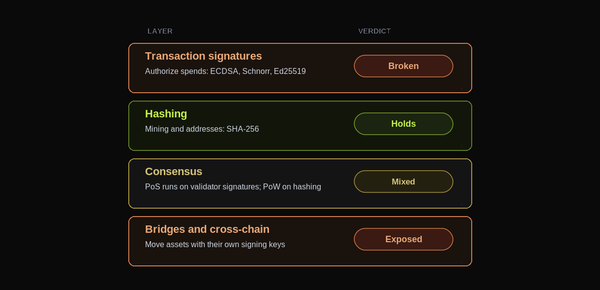
A blockchain isn't a single cryptographic object. It's a stack comprising transaction signatures that authorize spends, hash functions that link blocks and build addresses, a consensus mechanism that agrees on history, and the bridges that move assets to other chains. Quantum computing hits these layers differently, so quantum-resistant has to be read layer by layer, as the headline says.
Two quantum algorithms set the terms. Shor's algorithm breaks the factoring and discrete-log assumptions behind widely used public-key signatures, including ECDSA, Schnorr, EdDSA, and BLS. Grover's algorithm speeds up brute-force search of hashes, a smaller threat than Shor poses to signatures.
Most of the danger sits with the first.

A blockchain's four layers and how quantum computing hits each. The exposed layer is the transaction signatures; hashing, consensus, and bridges range from sturdy to inherited risk.
The signature layer carries the risk
Most major chains authorize transactions with elliptic-curve signatures: ECDSA on Bitcoin and Ethereum, Schnorr on Taproot, Ed25519 on Solana, and BLS used for consensus signatures in some validator sets. A large enough quantum computer running Shor's algorithm can recover the private key from an exposed public key and forge a signature.
Google researchers modeled attack circuits that break secp256k1, the curve used by Bitcoin. They need about 1,200 to 1,450 logical qubits, which under Google's hardware assumptions works out to fewer than 500,000 physical superconducting qubits. That's a modeled figure, far beyond any machine that exists today.
The fix is a post-quantum signature scheme.
NIST finalized standards in this family, ML-DSA and SLH-DSA, in 2024, and selected Falcon for standardization as FN-DSA, which isn't final yet. Any chain that claims quantum resistance needs a signature scheme believed to withstand known quantum attacks, whether a finalized NIST standard like ML-DSA or SLH-DSA, another standardized design, or a carefully implemented hash-based scheme like XMSS.
If you get this layer wrong, nothing will save the chain.
The hash layer is sturdier
Hashing worries people more than it should, but its protection does have limits. Grover's algorithm gives a quadratic speedup for generic preimage search, which lowers the effective strength of a 256-bit hash to about 128 bits. That is a genuine exponential reduction, and 128 bits is still far out of reach.
A longer hash makes up the difference. A 512-bit hash gives back the strength Grover shaves off a 256-bit one.
The proof-of-work mechanism doesn't collapse the way elliptic-curve signatures do, though it takes a hit too. Grover-style search could give a capable quantum miner an edge in finding valid nonces.
Whether that becomes an economically useful or consensus-threatening advantage depends on gate speed, error-correction overhead, and block timing.
Address hashing helps too, but with one catch. On P2PKH and P2WPKH outputs, Bitcoin stores a hash of the public key, so a previously unused key is revealed only when you first spend from that address. Even so, that doesn't cover every output type: Taproot commits to a public key directly, and a reused key may already be public.
Those address hashes use a 160-bit function, so their generic quantum margin is narrower than the 256-bit hashes behind mining. And once a public key is exposed, it remains exposed, so the risk stays with the key from then on.

Shor breaks an elliptic-curve signature outright. Grover only halves a hash's strength, leaving about 128 bits. That difference is why quantum resistance is a signature problem first.
Consensus, bridges, and what people forget
For an entire network to qualify as quantum-resistant, it takes more than fixing user transactions. A proof-of-stake chain runs on validator signatures, so its consensus inherits the same Shor exposure as the accounts it secures.
Bridges and cross-chain messaging sign with their own keys as well. A 2025 systematization of research points to those signing surfaces as the main way post-quantum attackers break a chain, and hashing is a lesser concern.
Chains built for quantum resistance, and chains catching up
A few chains were designed around post-quantum signatures. One example is the Quantum Resistant Ledger that launched in 2018 on XMSS, a stateful hash-based scheme. This means the signer has to track which one-time keys it has used and never reuse them.
Its production network still runs on XMSS and proof of work. The project is testing Zond, a proof-of-stake network intended to succeed it, built around ML-DSA-87, the standardized form of Dilithium.
On that testnet, validators use ML-DSA, and general wallets can use ML-DSA or XMSS. Until Zond replaces the mainnet, QRL's deployed protection is the XMSS chain, and the ML-DSA migration is still ahead.
An established chain can also add post-quantum verification without launching a successor. Algorand has signed its state proofs with Falcon since 2022 and added the native falcon_verify opcode through a 2024 consensus upgrade.
In November 2025, the Algorand Foundation used that capability to run what it described as the first post-quantum transaction on its mainnet. Its ordinary accounts still use Ed25519, so the migration is unfinished, though the protocol-level support for post-quantum signatures is already live. As of September 2026, its roadmap adds SDK support for deriving Falcon-1024 accounts with the Q3 2026 release.
Where the largest networks are concerned, none has finished a protocol-level migration, and they sit at different stages. In qLABS' own L1 Quantum Vulnerability Index, Bitcoin receives the highest vulnerability score and Cardano the strongest preparedness score, with Ethereum, XRP (which the index lists as targeting 2028), and Solana in the active group.
Those rankings follow qLABS' methodology and don’t represent an industry consensus.
Bitcoin's $1.55 trillion market capitalization (qLABS' April 30, 2026 snapshot) feeds its economic-exposure score. This number measures the network's market value, which dwarfs the value an attacker could move at once.
Bitcoin's BIP 360 proposal would reduce long-exposure risk by keeping public keys out of the output, but it hasn't been accepted yet.
A shortcut before the base layer migrates
Holders on smart-contract chains don't have to wait for the base layer to migrate.
A smart contract can require a valid post-quantum signature before it releases funds. Then breaking the ordinary elliptic-curve key isn't enough to move them, as long as every path that can move funds or change the rules enforces that check. That includes upgrade permissions, recovery paths, guardian keys, and replay protection.
This adds protection at the application layer, on top of a chain that hasn't migrated, and it's only as strong as the contract's own design and the base chain underneath it.
qLABS applies this model in qVAULT, which it describes as a non-custodial HyperEVM vault that requires a Falcon-based authorization for withdrawals. It says the launch build covers qONE and HYPE, with Ethereum and stablecoins planned, and that Fairyproof, a smart-contract security auditor, reviewed the code.
Because it's a smart-contract tool, it can't cover BTC held natively on Bitcoin.
These are first-party claims, so review the audit report, its scope, the deployed contract addresses, and the verified source code before relying on them.
As noted up top, qLABS publishes the index cited here and stands to benefit from the product. Depositing into any third-party contract carries its own risk, and none of this is financial advice.
What this means for you
Transaction signatures are the most urgent quantum-migration problem, and they're where the clearest danger sits. The hashing that secures mining and addresses holds up better under Grover, with a margin that depends on the hash length.
But protecting the entire chain also means checking validator authentication, bridges, governance keys, and the randomness that consensus leans on. The chains that are ahead are the ones already running post-quantum verification in their protocol, like Algorand's Falcon support and QRL's hash-based signatures. A roadmap alone doesn't guarantee a place among them.
When a project calls itself a quantum-resistant blockchain, verify which layers it has moved, and whether every signing surface is covered.
FAQ
Which blockchain is the most quantum-resistant?
Among purpose-built chains, the Quantum Resistant Ledger is the clearest example. It signs at the protocol level with hash-based XMSS keys today and is testing a move to ML-DSA-87. Algorand has moved furthest where the established smart-contract chains are concerned, with Falcon verification live in its protocol. None of the largest networks are fully quantum-resistant yet. qLABS scores Cardano the most prepared, which describes the direction of travel more than a finished migration.
Is Bitcoin a quantum-resistant blockchain?
No. Bitcoin authorizes spends with ECDSA and Schnorr, both breakable by a capable quantum computer, and it hasn't adopted a post-quantum migration yet. Its proof-of-work mining, which relies on SHA-256 hashing, does better, though a capable quantum miner could gain a speedup in nonce search. The weak spot is the signatures, and millions of BTC already sit in addresses whose public keys are exposed.
Does proof of work make a blockchain quantum-resistant?
Only in part. Proof of work rests on hashing, which survives Grover's speedup with a wider margin than signatures keep, so mining is far less exposed. A capable quantum miner could still gain a quadratic boost in finding nonces. And a proof-of-work chain authorizes transactions with elliptic-curve signatures, which remain exposed to Shor. Consensus and signing are separate issues.
Can an existing blockchain go quantum-resistant without a hard fork?
Sometimes. Algorand added native Falcon verification through its standard protocol-upgrade process and ran a post-quantum mainnet transaction in November 2025 without launching a new chain. Migrating every existing account is harder. Some chains will need a coordinated network-and-account migration similar to QRL's planned move from its legacy chain to Zond. The tooling can arrive step by step, and moving all the funds takes longer.
What makes a blockchain quantum-resistant?
To qualify as quantum-resistant, a blockchain needs post-quantum signatures enforced across the system's signing surfaces, including user accounts, validator consensus, bridges, governance keys, and recovery mechanisms. The hashing layer usually fares better, though shorter address hashes keep a smaller quantum margin than full 256-bit hashes. The claim should name a specific standardized scheme, something like ML-DSA or a Falcon-based design, backed by working code. A 'quantum-ready' label on the box proves nothing by itself.
qLABS Editorial. Sources are linked inline. See the L1 Quantum Vulnerability Index for our full methodology and conflict-of-interest disclosure.