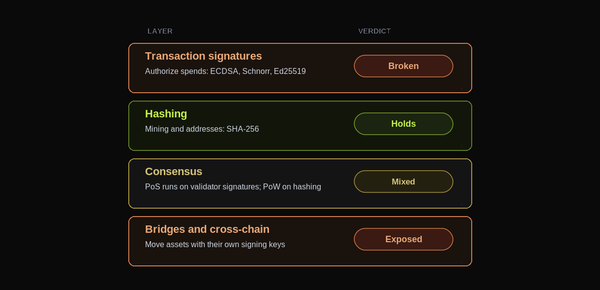
As of the time of writing, no post-quantum migration plan appears in Hyperliquid's public documentation or official code repositories. And its published materials don't name the cryptographic primitive behind HyperBFT consensus signatures, so the validator-level exposure can't be described as precisely as the user-account one.
Quantum-vulnerable user signing, and no announced plan
Hyperliquid's user-facing signing paths use Ethereum-compatible recoverable signatures. HyperEVM transactions use the familiar EVM account model, and HyperCore actions use EIP-712 signing flows described in Hyperliquid's SDK. Shor's algorithm can recover a private key from an exposed public key and forge a signature, so those user signatures are the exposed layer.
That signature math is well understood, and so is the attack on it. Google researchers modeled two circuits for breaking secp256k1: one using no more than 1,200 logical qubits and 90 million Toffoli gates, and another using no more than 1,450 logical qubits and 70 million Toffoli gates.
Under the paper's superconducting-hardware assumptions, the authors estimated that either could run with fewer than 500,000 physical qubits. No machine today can run either attack.
How Hyperliquid signs, and why that's the exposure
Hyperliquid uses Ethereum-style accounts. HyperCore users authorize actions like orders and transfers with Ethereum-compatible signatures, and HyperEVM transactions use the standard EVM model. Fills come from matched orders, so a trader doesn't separately sign each one, and liquidations are protocol-triggered events that the liquidated account doesn't sign.
The account model is the same shape as Ethereum's. An address is a hash of your public key, so the key is hidden until you act. Once a given account or API key signs, its public key can be recovered from the signature. Active Hyperliquid accounts normally reveal a recoverable signing key early in their history.
Traders can route routine orders through separate API wallets, which compartmentalizes the trading key from the main account, though it doesn't make either key post-quantum secure. Once a vulnerable public key has been exposed, it remains available as a future target whether or not the key signs again.
Consensus, and why speed doesn't help
Hyperliquid's selling point is speed. Its documentation reports median end-to-end order latency near 0.2 seconds, with a 99th percentile of 0.9 seconds for a geographically co-located client. That performance is a product strength, and it does nothing for the cryptography underneath.
Consensus layer is harder to pin down. HyperBFT rounds carry signatures from a validator quorum, and the active set is the top 27 validators by stake, but Hyperliquid's documentation doesn't name the signature scheme those consensus messages use. So the user-account exposure is clear, and the validator-level exposure can't be pinned down from what's published.
Whole-chain quantum resistance means every signing surface has to move, and on Hyperliquid the consensus surface is the part still undocumented.

Hyperliquid's user signatures are quantum-vulnerable; the consensus signature scheme isn't named in public docs, so validator-level exposure can't be pinned down.
What Hyperliquid has said about quantum
As of the time of writing, no post-quantum migration plan appears in Hyperliquid's public materials. It hasn't publicly matched Ethereum's post-quantum research effort, or the experimental post-quantum work on Solana and the XRP Ledger. Hyperliquid hasn't set out a base-layer migration path, so its protocol offers no built-in post-quantum signing option yet.
A base-layer fix would be a big job. It would mean changing how user accounts authenticate, and assessing the consensus signature scheme to replace it if it relies on quantum-vulnerable cryptography, coordinated across a live, high-throughput network without breaking it. That kind of migration tends to begin with public research and a stated design, and Hyperliquid hasn't taken that first step in public.

On published preparedness, Hyperliquid trails Ethereum's research and the experimental work on Solana and the XRP Ledger. None has a finished base-layer migration.
What HYPE holders can do now
Address hygiene can't make Hyperliquid quantum-safe, because active accounts and authorized trading keys are routinely reused. Separate API wallets and dedicated trading accounts can still compartmentalize exposure, though they don't replace a post-quantum protocol upgrade.
There's a limit to what any holder can do as long as the base layer stays on elliptic-curve signatures. A vault protects what's inside it, and it doesn't change how the chain reaches consensus. So the app-layer route guards specific holdings, and the full fix still has to come from the protocol itself.
On a smart-contract chain, a vault can require a post-quantum signature before it releases assets, so the ordinary wallet key alone isn't enough to move them.
qLABS says its qVAULT is a non-custodial HyperEVM vault whose withdrawal path requires Falcon-based authorization. Its materials list HYPE and qONE as supported assets, with qONE paying for the vault's post-quantum verification and HYPE remaining the network's gas token.
This can stop possession of the ordinary key from authorizing a compliant withdrawal, and it doesn't make HyperBFT quantum-safe or guard against a consensus failure or a flaw in the contract or its upgrade path. None of this is financial advice.
Fast chain, no quantum plan yet
Hyperliquid isn't quantum-safe today. Its user-facing signing paths rely on Ethereum-compatible elliptic-curve cryptography, and the project hasn't published a post-quantum migration plan yet. Its speed doesn't change that exposure.
Application-layer vaults can add an additional post-quantum authorization requirement for particular assets, and they don't upgrade HyperBFT or the chain as a whole. No capable quantum attacker exists today, and the timetable is uncertain. The open question is whether Hyperliquid starts planning before that uncertainty turns urgent.
FAQ
Is Hyperliquid quantum safe?
Not today. Hyperliquid's user actions and EVM transactions authenticate with Ethereum-compatible elliptic-curve signatures, which a large enough quantum computer could forge, and no post-quantum roadmap appears in its public materials as of the time of writing.
Can a quantum computer steal my HYPE?
Not with today's hardware. The risk arrives if a capable quantum computer is built and your account's public key is exposed, which happens when the account signs. Once a key is exposed it stays a target, though the attack itself is still in the future. Assets held in a vault that adds a post-quantum check are a separate case.
Does Hyperliquid have a post-quantum plan?
None appears in its public documentation or code repositories as of the time of writing. Ethereum has an active public research effort, and Solana and the XRP Ledger have run experimental post-quantum work. A credible Hyperliquid plan would start with public research and a stated migration design.
Is Hyperliquid more exposed than Ethereum?
At the user-account level, the cryptography is alike: Ethereum-compatible signatures with reused accounts. The clearer difference is preparedness. Ethereum has an active migration effort, and Hyperliquid hasn't published one, which puts it behind on that measure yet. Hyperliquid's consensus-level exposure is harder to compare, since its documentation doesn't name the primitive its validators sign with.
How can I protect assets on Hyperliquid?
Until the base layer changes, one available application-layer option is a HyperEVM vault that adds a post-quantum authorization check to the assets it holds. Separate API wallets can compartmentalize a trading key, and following any future base-layer plan is the other half of the equation. Remember, none of this is financial advice.
qLABS Editorial. Sources are linked inline. See the L1 Quantum Vulnerability Index for our full methodology and conflict-of-interest disclosure.