If you’re a crypto holder, the Y2Q deadline is important for your ability to spend, because the elliptic-curve signatures that authorize spending may become practically breakable. The algorithms that most major chains rely on may fall victim to the same quantum attack, and we cover the mechanics of it in Can Quantum Computers Break Blockchain?. This guide is all about the framing: what the Y2K comparison gets right, and where it misleads.
What Y2Q means
Y2Q is the countdown to what's often called Q-Day, the emergence of a quantum computer powerful enough to use Shor's algorithm to break deployed cryptographic keys. Strictly speaking, Y2Q refers to the years remaining until such time, and Q-Day is the dreaded day that they run out, though they’re now used interchangeably.
In other words, this isn't a scheduled event, and no one can name the exact year, which we get into in When is Q-Day?. The term exists to give a wide-reaching, technical threat a name that organizations and individuals can plan around, the same job Y2K did back in the 1990s.
That naming is the first thing the two share. Y2K took one detail, which is date fields routinely storing and showing years as two digits, and turned it into a deadline that organizations could budget and work toward. Y2Q does a similar thing for a threat most people would otherwise wave off as science fiction. When the threat has been given a name that also points at a deadline, the logical next question becomes what to do before it arrives.
What the Y2K comparison gets right
If we look beyond the surrounding drama, preparing for Y2K was a big technical job, and a successful one, for that matter. The strongest parallels with Y2Q are the practical ones.
Both are recognized problems with a known route to solution. Y2K was hardly a mystery. In fact, the flaw was understood, and the remedy was to update or replace the affected systems and test the result. Y2Q is the same in this manner.
The vulnerable cryptography has been named, and standardized replacements for its two main uses (key establishment and digital signatures) now exist. However, the more difficult task is figuring out how to integrate them into infrastructure built around distinct algorithms. Neither needs a breakthrough to start, but both require effort to be applied early.
Also, both Y2Q and Y2K reward inventory over panic. The first job in Y2K was taking stock of every system that stored or processed dates. In Y2Q’s case and a post-quantum migration it warrants, the primary task is finding every place that uses vulnerable cryptography. It’s easier said than done, since these vulnerabilities hide in protocols, firmware, libraries, and dependencies nobody has documented yet. You can't replace what you haven't found.
And both are unspectacular and tedious. They involve audits, upgrades, testing, and coordination across teams that would rather do anything but that. Still, Y2K got done because organizations stepped up and seriously dedicated years and effort to tackling a boring problem. Y2Q asks for the same treatment.
Where the analogy breaks
Four differences stand out between Y2K and Y2Q, and each makes the latter more complicated.

Y2Q borrows Y2K's shape but is harder on four counts: no fixed date, quieter failures, backward-reaching damage, and a trust-layer migration instead of a patch.
First, Y2K had an exact date. Everyone knew the deadline was midnight on January 1, 2000, which made planning simple, as you could work backward from a fixed point. Y2Q doesn’t have such a point. Serious forecasts are probabilistic at best, and a recent expert survey puts a capable machine at better than even odds within about 15 years. This means there’s no clean date to count down to, and the temptation is strong to treat the lack of a date as the lack of a deadline.
Secondly, many Y2K failures would have been operationally visible. Some of Y2Q's worst may not be. A Y2K bug could announce itself through a crash, a wrong date, a bad calculation, or something else equally obvious. Quantum failures can be harder to diagnose. A decrypted archive can be read without its owner ever realizing it, and a forged blockchain signature looks to the network like a legitimate transaction, so the theft would be evident but the break behind it wouldn’t be. The first clear sign of trouble is often the damage itself, and by then, it’s already too late.
The third thing is the retrograde extent of the damage. Y2K could corrupt calculations involving old dates, but it couldn't make an old secret suddenly readable. Y2Q might. The clearest case is encrypted data in the Harvest Now, Decrypt Later problem. A ciphertext captured today can be decrypted years later, even if the system has since migrated, because upgrading later can’t reach the copy the attacker already took.
Where crypto signatures are concerned, an exposed public key can be saved indefinitely, but it only turns into a theft if valuable assets still sit behind that key when a capable machine arrives. If you move the coins to an unexposed key before then, an attacker breaking the old key later wouldn’t give them anything. So, the two cases differ. With encrypted data, the loss is already locked in, and with crypto, it only happens if the coins stay on the exposed key.
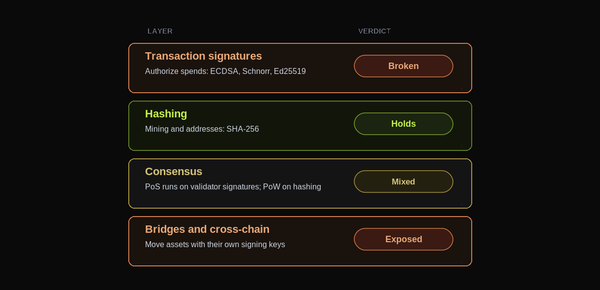
Lastly, Y2K was a one-time fix, whereas Y2Q requires a slower change to the very cryptography that systems trust each other with. Patching a date field didn't change how systems trusted each other. Replacing a signature scheme does. At the base layer, it can mean consensus changes, new account formats, new address types, and large-scale movement of assets, a slower and riskier upgrade than expanding a field, and one that has to hold for decades after. Some chains use more than one quantum-breakable piece of cryptography, so fixing them takes more than swapping a single algorithm.
The lesson of Y2K
It would be easy to fall into a trap of reading Y2K as not a big deal. The sky didn’t fall, life went on, so the whole thing must’ve been nothing more than hype, right? But this interpretation gets the causality backwards. A disaster was averted because governments and companies spent years and enormous budgets making sure it wouldn't. The fact that “nothing happened” was the entire goal. It was exactly this serenity that the years of preparation had brought.

A calm Q-Day is the goal, not proof the threat was overblown. The quiet only comes from doing the work first.
Y2Q carries the same trap in advance. If migration goes well, Q-Day could pass without a major security catastrophe, and it will be tempting to say the threat was overblown. What counts is whether the work got done in time. The drama on the day itself, or the lack of it, won’t tell you anything. An uneventful Q-Day would be the win, the same way an uneventful January 1, 2000, was.
Implications in the crypto sphere
The most immediate Y2Q problem that crypto holders will face is transaction authorization, or the signatures that decide who can move assets. A blockchain has to supply a post-quantum authorization path and move vulnerable holdings onto it before a capable quantum machine appears. And because migration takes years, the right time to begin is now, well ahead of any first sign of the threat.
Some protocols rely on more than one one quantum-breakable component, so the work can span well beyond the transaction signature alone. Where each major chain stands is scored in the L1 Quantum Vulnerability Index (qLVI), and Bitcoin's specific position is covered in the Is Bitcoin quantum safe? guide.
Holders are facing a smaller version of the same inventory-and-migrate task. Where the chain and address type allow it (as in the case of Bitcoin's hash-protected P2PKH or P2WPKH outputs), keep long-term funds behind addresses whose public keys haven't been revealed, so less sits exposed as the protocols catch up. That said, this only shrinks the window.
The key is still revealed when you spend your assets, and hiding it doesn't make the coins post-quantum safe. On smart contract chains, an application-layer option can add a post-quantum authorization step ahead of base chain migration. That’s the model behind qLABS’ qVAULT, a non-custodial vault that keeps funds behind a Falcon-based lock, so a broken elliptic-curve key on its own can’t move them. Its lock and unlock fees are paid in the qONE token.
This is one approach among several, alongside Cardano's and Ethereum's research. qLABS builds quantum-safe products and runs the index linked above. The methodology and conflict-of-interest statement are included in the qLVI, and none of this constitutes financial advice.
Reading Y2Q clearly
Y2Q is a fun name for a problem that’s anything but, as long as the Y2K comparison is held loosely. Take what the Y2K comparison gets right: a deadline to plan against, an inventory-first response, and the discipline to treat a boring migration seriously before it's urgent.
Make sure to drop the misleading parts: the fixed date, and the assumption that failure will be bombastic and the fix a one-time patch. The threat is more obscure than Y2K and more lasting, and the (potential) deadline sits further off. This combination makes it easy to shrug off, but don’t do it. The chains and holders who treat it like the big technical job it is will have an uneventful Q-Day. The rest will get a lesson of a lifetime, proverbial fireworks included.
FAQ
What does Y2Q mean?
Y2Q stands for "years to quantum," a name for the approach of the day a quantum computer can break widely deployed public-key systems such as RSA and elliptic-curve cryptography. It's closely tied to Q-Day, and deliberately echoes Y2K to give a technical threat a deadline around which organizations can plan.
Is Y2Q the same as Q-Day?
They're used interchangeably now, though they started slightly apart. Y2Q named the years remaining until the quantum threat, and Q-Day names the threshold itself. Usage has blurred the two, so many sources now call the event Y2Q.
When is Y2Q?
There's no fixed date for the Y2Q event. The Global Risk Institute's 2025 expert survey put a cryptographically relevant quantum computer at a 28% to 49% chance within 10 years and 51% to 70% within 15. We cover the timing question, and why a government deadline isn't a forecast, in When is Q-Day?.
Is Y2Q overblown, like some say Y2K was?
Y2K looks like a non-event in hindsight because years of preparation made it such. Y2Q carries the same risk of being misread. If migration succeeds, the day will pass without drama. That’s the preparation working as it should, the same way a calm January 1, 2000, meant Y2K got handled behind the scenes.
What should I do about Y2Q?
The same thing organizations did for Y2K: inventory the problem areas, then migrate. In the crypto sphere, that means two moves: check whether the chains on which you hold your assets are migrating to post-quantum signatures, and keep long-term holdings behind addresses whose public keys haven't been revealed (where the chain and address type allow). Start well before the deadline.
qLABS Editorial. Sources are linked inline. See the L1 Quantum Vulnerability Index for our full methodology and conflict-of-interest disclosure.